Hard Savings Challenge: A Comprehensive Evaluation
The Hard Savings Challenge—particularly the 75-day version often called the 75 Hard Savings Challenge—is a structured money-saving method that has gained attention among people seeking a disciplined, fast-track approach to building savings. Unlike softer or incremental savings plans, this challenge requires consistent, fixed contributions over a defined period, often 75 days, with the goal of accumulating a substantial sum. In its standard form, saving a constant amount each step leads to a total of $5,625 in just over two months. But is this challenge right for you? This article evaluates the Hard Savings Challenge from a practical, decision-oriented perspective, examining its benefits, tradeoffs, ideal use cases, and situations where alternative approaches may serve you better.
What Is the Hard Savings Challenge?
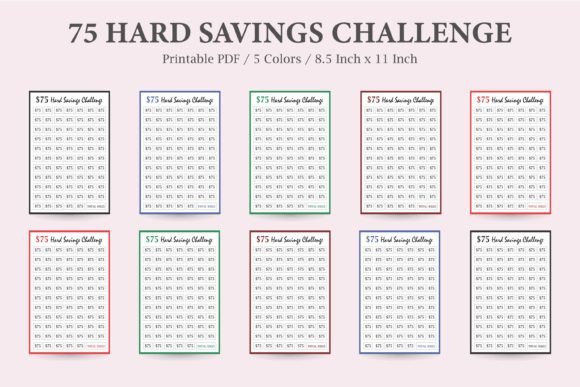
The Hard Savings Challenge is a derivative of the broader 75 Hard mindset, adapted specifically for financial goals. In its most common format, you choose a fixed amount—often $75—and save that amount each day or each cycle. Over 75 steps, the total reached is $5,625. The key distinction from other challenges is the constant increment rather than a gradually increasing amount. This means every saving action is identical in size, which simplifies tracking and removes the need to adjust your budget as you progress. Many people pair the challenge with a savings tracker printable or a finance goal tracker to visualize their progress and maintain accountability.
The challenge can be completed in 75 consecutive days, which is the most intensive version. Alternatively, you can spread the saving steps across separate periods—for example, saving a few amounts each week—making it adaptable to your cash flow and lifestyle. This flexibility is a core feature that differentiates it from rigid, day-by-day programs. Whether you prefer a 75-day money challenge or a longer 75 weeks of savings approach, the underlying principle remains the same: consistent, fixed contributions toward a defined target.
Why Consider the Hard Savings Challenge?
People are drawn to the Hard Savings Challenge for several reasons. First, the clear endpoint—75 steps—creates a sense of urgency and achievability. Knowing exactly how many saving actions are required helps with planning and motivation. Second, the constant amount removes the mental load of recalculating each step, which is common in progressive challenges like the popular 1-to-365 penny challenge. Third, the total savings of $5,625 represents a meaningful sum that can cover an emergency fund, a vacation, a down payment on a small purchase, or a debt repayment chunk.
Another draw is the challenge's alignment with a budgeting challenge mindset. Many people use it not just to save money, but to build the habit of consistent saving. The discipline required to set aside a fixed amount repeatedly can reinforce broader financial habits, such as tracking expenses, reducing discretionary spending, and prioritizing savings over consumption. The money saving challenge aspect also appeals to those who thrive on gamification—checking off each step on a tracker provides a dopamine hit that sustains momentum.
Benefits and Tradeoffs
Like any financial tool, the Hard Savings Challenge offers both advantages and limitations. Understanding these helps you decide whether it aligns with your personal financial situation and goals.
Benefits
- Speed of accumulation: Saving $5,625 in 75 days is a fast way to build a meaningful reserve. For someone with a solid income, this can be a powerful way to reach a goal quickly.
- Simplicity and predictability: Because each saving step is the same amount, you know exactly what is required. There is no need to adjust your budget upward each week or month, which reduces planning complexity.
- Flexibility in timing: You can complete the challenge in 75 consecutive days, stretch it over a few months, or even treat it as a 75-week program. This adaptability makes it suitable for irregular income earners or those who need to accommodate large periodic expenses.
- Reinforcement of discipline: The fixed, repetitive nature of the challenge builds a saving habit. Many participants report that after completing the challenge, they continue to save regularly, having internalized the practice.
- Clear tracking: Using a savings tracker printable or a digital finance goal tracker, you can see progress at a glance. This visual feedback is motivating and helps prevent dropout.
Tradeoffs and Considerations
- High daily or weekly requirement: For many people, saving $75 daily (or even $75 every few days) is not feasible without significant lifestyle changes. The challenge demands a certain level of disposable income, which may not be available to those with tight budgets or high fixed costs.
- Potential for cash flow strain: If you choose the consecutive-day version, you must have the liquidity to make each payment on schedule. A large unexpected expense could derail the challenge or force you to skip steps, reducing the total saved.
- Lack of gradual ramp-up: Unlike progressive challenges that start small and increase, the Hard Savings Challenge requires the same commitment from step one. This can be intimidating for beginners or those who have never consistently saved before.
- Opportunity cost: Tying up funds in a savings challenge might mean missing out on other uses of that money, such as investing in low-cost index funds, paying down high-interest debt, or building an emergency fund. If the money would be better deployed elsewhere, the challenge may not be optimal.
- Behavioral sustainability: While the challenge builds discipline during the 75 steps, some participants experience a rebound effect after completion, returning to previous spending habits. The challenge itself does not guarantee long-term change unless paired with broader financial education.
Situations Where the Hard Savings Challenge Is a Strong Fit
The Hard Savings Challenge works best when your financial situation meets certain conditions. Consider this challenge if:
- You have a stable, predictable income that covers your essential expenses and leaves a comfortable surplus. The fixed saving amount should not compromise your ability to pay bills or handle emergencies.
- You have a specific short-term goal that requires around $5,000 to $6,000. Examples include a vacation, a home improvement project, a used car purchase, or a wedding expense. The challenge provides a structured path to that target.
- You respond well to clear, bounded challenges with a definite end date. If you thrive on ticking boxes and seeing progress bars fill up, the 75-day money saving format will likely keep you engaged.
- You already have a basic emergency fund in place. Tying up money in a challenge is less risky if you have a safety net for unexpected costs. Without that buffer, a single crisis could force you to abandon the challenge.
- You want to test your saving discipline before committing to a longer-term plan. Completing the 75 steps can serve as a proof of concept, showing you that you are capable of consistent saving, which can then be extended into a permanent habit.
Situations Where Alternatives May Be Worth Considering
No single savings method works for everyone. The Hard Savings Challenge may not be ideal if you fall into any of the following categories:
- Your income is irregular or unpredictable. Freelancers, gig workers, or commission-based earners may find the fixed amount difficult to commit to on a regular schedule. An alternative like a percentage-based savings method—where you save a portion of each paycheck regardless of amount—offers more flexibility.
- You are just starting to save. Beginners often benefit from a gradual ramp-up, such as the 75 Soft Challenge or a weekly increasing saving plan. Starting with smaller amounts reduces the risk of failure and builds confidence.
- You have high-interest debt. Mathematically, paying down debt with an interest rate above 10% is usually more beneficial than saving in a low-yield account. In this case, a debt avalanche or snowball method might be a better use of your surplus cash.
- You prioritize long-term investing over short-term saving. If your goal is retirement or wealth accumulation over decades, consistent contributions to a diversified investment portfolio—even in small amounts—tend to outperform short-term savings challenges in the long run.
- You need a smaller, more flexible goal. The $5,625 target may be too large for your current capacity. A scaled-down version, such as saving $25 per step for a total of $1,875, might be more realistic. Alternatively, a 75 weeks of savings approach with a lower weekly amount could reduce the pressure.
Practical Decision-Making Insights
To decide whether the Hard Savings Challenge aligns with your goals, start by assessing your current financial landscape. Calculate your monthly surplus after all essential expenses and debt payments. If that surplus is at least 1.5 times the challenge's daily or weekly saving amount, you have room to participate without undue strain. If the surplus is smaller, consider a modified version with a lower fixed amount or a longer timeline.
Next, define your savings goal clearly. A specific, time-bound target—like "save $5,625 for a down payment on a car in 75 days"—gives the challenge purpose and makes it easier to stick with. Vague goals like "save more money" are less motivating. Write your goal on your financial goal tracker and place it somewhere visible.
Choose your tracking method. A savings tracker printable is a popular low-tech option; you can find free templates online or create your own. Alternatively, use a spreadsheet or a savings app that allows custom tracking. The key is to update it consistently—ideally after each saving step—to maintain momentum.
Consider combining the challenge with a broader budgeting challenge. For example, during the 75 days, commit to cutting one non-essential expense, such as dining out or subscription services, and redirect that money toward your savings. This dual approach reduces the burden of finding extra cash and reinforces frugal habits.
Finally, plan for what happens after the challenge. If you successfully save $5,625, decide in advance where that money will go. Having a plan reduces the temptation to spend it impulsively. You might also consider repeating the challenge at a lower amount or transitioning to a regular automated savings plan to sustain your new habit.
Helping You Decide: Is the Hard Savings Challenge Right for You?
The Hard Savings Challenge is a tool, not a solution. It works best for people who have the income to support consistent fixed contributions, a clear short-term goal, and a preference for structured, bounded challenges. Its strengths are speed, simplicity, and the motivational power of a visible end point. Its main tradeoffs are the upfront financial commitment, the lack of a gradual ramp-up, and the potential for cash flow strain if your finances are tight or irregular.
If you fit the profile described above—stable income, existing financial buffer, and a specific goal—the Hard Savings Challenge can be an effective way to accumulate a meaningful sum quickly. If your situation is more uncertain, or if you are new to saving, consider a modified version or an alternative method that better matches your capacity and risk tolerance. The best savings challenge is the one you can actually complete without compromising your financial stability.
Ultimately, the Hard Savings Challenge offers a structured pathway to saving $5,625 in a short period. By evaluating your personal finances, goals, and behavioral preferences, you can determine whether this approach aligns with your needs. If it does, the challenge can serve as a powerful catalyst for building both savings and discipline. If it does not, many other saving methods exist to help you progress at your own pace. The key is to choose a strategy that you can stick with consistently—because consistent saving, regardless of the method, is what truly moves you toward your financial goals.