Unlocking Learning and Publishing Potential with Word Search Puzzles for Kids Vol 2
Word search puzzles for children occupy a unique space where playful activity meets purposeful learning. They are not merely grids of letters but carefully constructed tools that build vocabulary, sharpen pattern recognition, and foster concentration. For parents, educators, and content creators, these puzzles represent a versatile resource that can be adapted for classroom enrichment, home entertainment, or commercial publishing. Word Search Puzzles for Kids Vol 2 embodies this blend of fun and function, offering a substantial collection that serves both young solvers and the adults who create for them.
What makes a word search puzzle collection truly valuable is not just the number of puzzles it contains, but how those puzzles are designed, how they can be deployed across different contexts, and how they support the broader goal of keeping children engaged with language. This article explores the multifaceted nature of word search puzzles for kids, examining their educational underpinnings, their role in the KDP publishing ecosystem, and the practical considerations that turn a set of puzzles into a meaningful product.
The Cognitive Architecture of Word Searches for Young Minds
At first glance, a word search appears to be a simple scanning exercise. Yet the cognitive processes it activates are surprisingly rich. When a child searches for a word like "elephant" or "garden," they must hold the target word in working memory, visually scan the grid for the first letter, then systematically check surrounding letters to confirm the sequence. This multi-step operation strengthens several cognitive faculties simultaneously.
Pattern recognition is perhaps the most obvious skill being exercised. Children learn to identify letter clusters within a noisy visual field, a skill that transfers directly to fluent reading, where recognizing whole words and common letter combinations is essential. Additionally, the directional nature of word searches—words can be placed horizontally, vertically, or diagonally, forward or backward—trains the brain to process information from multiple orientations. This kind of spatial flexibility is valuable for reading, mathematics, and even navigation.
Vocabulary acquisition occurs naturally during puzzle solving. Word Search Puzzles for Kids Vol 2 likely organizes its puzzles around thematic categories—animals, seasons, colors, occupations, or holiday terms. This thematic clustering creates a semantic web where words are learned not in isolation but in relation to one another. A child solving a puzzle about the ocean encounters "whale," "coral," "tide," and "dolphin" together, reinforcing the conceptual category while practicing spelling and letter recognition.
Moreover, word search puzzles build persistence and attention to detail. Unlike some digital games that provide instant feedback and rapid rewards, a word search requires sustained focus over several minutes. The satisfaction of finding a hidden word after diligent scanning teaches children that patience and methodical effort yield tangible results. This is a gentle but powerful lesson in self-regulation and goal-directed behavior.
Age Appropriateness and Puzzle Design Considerations
Not all word searches are created equal, especially when the target audience is children. Puzzle designers must consider grid size, word length, letter case, and the complexity of word placement. For younger children (ages 4–7), smaller grids (8×8 or 10×10) with larger fonts, only horizontal or vertical word placements, and familiar three- to five-letter words are ideal. For older children (ages 8–12), larger grids, diagonal placements, backward words, and more challenging vocabulary become appropriate.
The puzzles included in a collection like Word Search Puzzles for Kids Vol 2 are presumably designed with these developmental stages in mind. The value for educators and parents lies in being able to select puzzles that match a child's current abilities while still offering a slight stretch. When puzzles are too easy, children become bored; when too difficult, they become frustrated. A well-curated set offers a gradient of challenge that keeps children in the zone of proximal development—where learning is optimized.
Empowering KDP Creators with Ready-Made Content
For anyone involved in Kindle Direct Publishing, especially those specializing in children's activity books, content creation is both the most rewarding and the most time-consuming part of the business. Designing original puzzles from scratch requires not only subject knowledge but also layout skills, attention to formatting standards, and a significant investment of time. This is where pre-made puzzle collections become invaluable assets.
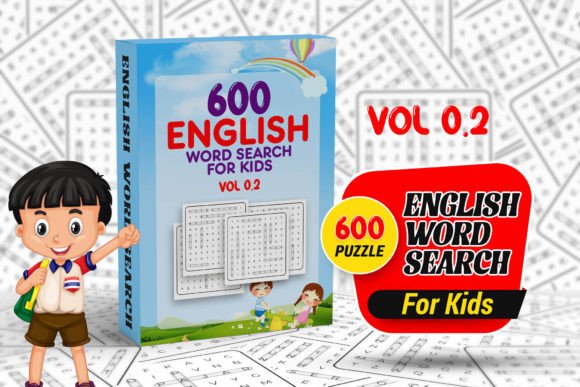
📢 600 Engaging Word Search Puzzles for Kids Vol 2 – Ideal for Kids KDP Creators is precisely the kind of resource that streamlines the publishing workflow. With 600 individual JPEG images, each containing a fully formed word search puzzle, creators can bypass the laborious process of generating grids and word lists. Instead, they can focus on the creative assembly of their book—arranging puzzles, designing cover art, adding supplementary content like coloring pages or mazes, and crafting the overall user experience.
The JPEG format is particularly practical because it is universally compatible. Whether a publisher uses Canva, Adobe InDesign, Affinity Publisher, or any other design software, these images can be imported, scaled, and arranged with minimal friction. The puzzles are ready to drop into a book layout, which saves countless hours of manual entry and reduces the risk of typographical errors that can occur when transcribing word lists or letter grids.
From a business perspective, this bundle offers a path to rapid product development. A KDP creator could take the 600 puzzles and divide them into multiple volumes—perhaps volume 1 for easy puzzles, volume 2 for medium difficulty, and volume 3 for challenging puzzles. Alternatively, they could create thematic books: "Animal Word Searches," "Holiday Word Searches," "Science Word Searches," and so on. The versatility of having a large, unified collection means that one purchase can feed an entire product line.
Quality Control and Brand Differentiation
One of the common concerns about pre-made content is the risk of producing books that feel generic or indistinguishable from competitors. Savvy KDP creators use several strategies to overcome this. First, they customize the presentation. Even though the puzzle images themselves are provided, the layout, cover design, interior formatting, and supplementary content are entirely under the creator's control. A distinctive cover and a well-organized interior can make a book feel unique even if the core content is sourced from a common bundle.
Second, creators can layer additional value on top of the puzzles. For instance, they might include a "word bank" section where children can write definitions for each word they find, or a "challenge tracker" that encourages kids to time themselves and beat their own records. Adding a certificate of completion at the end of the book is another simple but effective way to increase perceived value and encourage positive reviews.
Third, thoughtful curation matters. Not every puzzle from a collection of 600 needs to appear in every book. A creator can select puzzles that align with a specific theme, reading level, or age group, then arrange them in a sequence that feels intentional rather than random. This curation process, though modest, transforms a generic asset into a tailored product.
📢 600 Engaging Word Search Puzzles for Kids Vol 2 – Ideal for Kids KDP Creators provides the raw material, but the creator's editorial judgment determines the final quality. The bundle is a foundation upon which a distinctive book can be built.
Educational Applications Beyond the Book Market
While the KDP angle is compelling, it would be a mistake to view word search puzzles solely through a commercial lens. Teachers, homeschoolers, and tutors are equally served by collections like Word Search Puzzles for Kids Vol 2. In classroom settings, these puzzles serve as
- Warm-up activities that settle students into a focused state at the start of a lesson.
- Vocabulary reinforcement tools that follow a spelling test or a reading comprehension exercise.
- Early finisher tasks that keep engaged students productive while others complete their work.
- Centers or station activities that can be rotated among small groups.
The thematic organization of puzzles makes it easy for educators to align them with curriculum units. A science unit on the solar system can be paired with a space-themed word search; a social studies unit on communities can be complemented by a puzzle featuring neighborhood-related words. This alignment deepens the learning experience and gives children an additional modality through which to interact with the material.
For homeschoolers, word search puzzles offer a structured yet flexible activity that can be completed independently. Parents appreciate that the puzzles are self-contained and require minimal setup—just a printed page and a pencil. They also provide a screen-free alternative that still delivers educational value, which is increasingly sought after in an age of digital saturation.
Differentiation for Diverse Learners
Word search puzzles can also be adapted for children with different learning needs. For English language learners, puzzles provide a low-anxiety context for encountering new words in written form. The visual nature of the task supports comprehension without relying heavily on auditory processing. For children with attention differences, the clear goal and finite timeframe of a word search can be more motivating than open-ended assignments. For gifted learners, puzzles with more complex word placements and less common vocabulary offer appropriate challenge without requiring additional teacher intervention.
📢 600 Engaging Word Search Puzzles for Kids Vol 2 – Ideal for Kids KDP Creators contains enough variety that educators and parents can select puzzles tailored to individual students. The sheer volume ensures that no child runs out of fresh content, and the range of topics keeps the activity novel and engaging over time.
Practical Implementation for Maximum Value
Whether you approach this collection as a publisher, educator, or parent, maximizing its value requires some forethought. Here are several practical strategies:
- Organize by theme and difficulty. Create a system for categorizing the puzzles—by subject, by word count, by grid size, or by age recommendation. This makes it easy to find the right puzzle at the right moment.
- Create printable packets. For classroom or homeschool use, assemble packets of 10–15 puzzles with a common theme. Include a cover page and a tracking sheet so students can monitor their progress.
- Incorporate puzzles into a reward system. Some children respond well to completing a puzzle as a "challenge mission" that earns a small privilege or sticker. The finite nature of a word search makes it an ideal unit for such systems.
- Use puzzles as assessment tools. After a unit of study, a word search can serve as a low-stakes check of whether students can recognize and spell key vocabulary words. It is more engaging than a traditional quiz while still providing diagnostic information.
- Bundle with complementary activities. Pair a word search with a crossword, a coloring page, or a short writing prompt about the same theme. This creates a mini-unit that addresses multiple skills and keeps children engaged for a longer period.
- Repurpose for digital use. While the puzzles are provided as JPEGs, they can be imported into annotation apps or interactive whiteboard software for use on tablets or smartboards. This extends their utility beyond print.
Why Quality and Quantity Both Matter
In a collection of 600 puzzles, quality control is paramount. The puzzles must have accurate grids, correctly placed words, and age-appropriate vocabulary. They must be visually clear, with sufficient contrast between the letters and the background. They must also be free of errors—missing letters, duplicate words, or clues that don't match the grid. A bundle that delivers on these fronts saves creators from the tedious work of proofreading and debugging each puzzle.
📢 600 Engaging Word Search Puzzles for Kids Vol 2 – Ideal for Kids KDP Creators appears designed with these standards in mind. The large quantity is not just a selling point; it is a practical feature that enables creators to produce multiple books without redundantly purchasing content. It also gives educators and parents a long-lasting resource that won't be exhausted after a few uses.
The combination of educational soundness and commercial practicality makes this bundle a standout option. It respects the child's developmental journey while supporting the creator's business goals. It is a tool that, in the right hands, can produce books that children genuinely enjoy and that parents feel good about buying.
Looking Ahead: The Enduring Appeal of Word Searches
Word search puzzles have been a staple of children's activity books for decades, and their popularity shows no sign of waning. They succeed because they offer a perfect balance: they are challenging enough to be interesting but structured enough to be achievable. They require no special equipment or prior knowledge. They can be done alone or together, quietly or collaboratively. And they deliver a small burst of satisfaction with every word found.
For KDP creators, the opportunity is clear. The children's activity book market continues to thrive, driven by parents and educators who seek affordable, screen-free, skill-building content. A well-produced word search book that is age-appropriate, visually appealing, and packed with variety can attract positive reviews, repeat purchases, and word-of-mouth recommendations.
Word Search Puzzles for Kids Vol 2 represents one piece of that larger puzzle—a resource that, when used thoughtfully, can help creators build a sustainable publishing business while delivering genuine educational value to children. The key is to approach it not as a shortcut but as a foundation: a starting point for creative book design, thoughtful curation, and a commitment to quality that will set your products apart in a competitive marketplace.
Whether you are a first-time KDP creator looking for a reliable content source, a teacher seeking fresh materials for your classroom, or a parent wanting to supplement your child's learning at home, a well-crafted word search collection offers something valuable. It turns idle moments into learning opportunities. It makes vocabulary practice feel like play. And it proves that sometimes, the simplest tools are the most effective.