52-Week Mental Health Journal Prompts: Design Insights
Imagine opening a perfectly crafted 52-week mental health journal, where every prompt feels both intimate and intentional—each page a visual journey that guides reflection without distraction. This is exactly what the 52 Week Mental Health Journal Prompts offers, and as a graphic designer, you have the unique opportunity to shape that experience. With the Editable 52 Week Mental Health Journal Prompts Canva Interior, you gain not just content, but a flexible design system that elevates personal wellness into a polished, professional product.
Why Design Matters in Reflective Tools
When creating a journal for mental health, every visual choice carries weight. Typography sets the tone—serif faces evoke warmth and tradition, while clean sans-serifs promote clarity and calm. A restrained color palette, perhaps muted pastels or earth tones, can reduce cognitive load and encourage honest introspection. For designers, the challenge is balancing aesthetic appeal with usability: margins must breathe, line spacing must invite writing, and each prompt should feel like a gentle nudge, not an overwhelming demand.
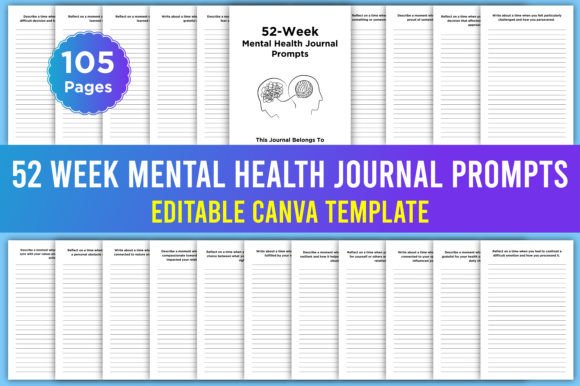
The 52 Week Mental Health Journal Prompts product addresses this by offering a complete interior designed at 6x9 inches, with CMYK color and 300 DPI for crisp print results. The 105 pages include no bleed, meaning your layouts stay clean and professional from page to page. Having an editable Canva link allows you to customize elements like font weights, accent colors, or iconography without starting from scratch—critical when adapting the journal for different audiences or brand systems.
Key Design Considerations for Journal Interiors
- Visual hierarchy: Use headings, subheadings, and white space to guide the eye through weekly prompts. The 52-week structure benefits from consistent headers and subtle section breaks.
- Readability and scalability: Ensure text remains legible at print and digital sizes. The provided JPEG and PNG files allow previewing how elements render across platforms.
- Color psychology: Soft blues and greens can lower anxiety; warm ochres invite creativity. The editable Canva file lets you experiment with palettes while keeping the overall harmony intact.
From a branding perspective, this journal can serve as a cornerstone asset for wellness coaches, therapists, or content creators who need a cohesive visual identity. Consistency across the 52-week cycle—through repeated motifs, aligned grid systems, or recurring accent elements—builds trust and reinforces the brand’s commitment to user experience.
Practical Applications Across Design Projects
The editable nature of this product means it’s not limited to print journals. Designers can repurpose individual pages for social media graphics (think Instagram prompts or Pinterest pins), email newsletter headers, or even short video transitions. The high-quality PDF files ensure that if you migrate the design to other tools, the resolution remains intact. Here are a few ways to extend the asset:
- Marketing materials: Use a single week’s layout as a teaser in email campaigns or blog posts.
- Editorial design: Blend prompt pages into magazines or workbooks for a cohesive series.
- Digital products: Convert layouts into interactive PDFs or low-resolution previews for online marketplaces.
- Branding collateral: Align the journal’s typography and color palette with your client’s existing brand identity for a seamless expansion.
When evaluating design elements, always consider the user’s journey. A visual hierarchy that highlights the prompt number, date, or space for notes can improve engagement. For example, placing the question at the top with a delicate ornament, followed by ample writing lines, respects the user’s need for both guidance and freedom. Similarly, incorporating subtle icons or simple illustrations (which you can edit in Canva) can break up text without overwhelming the reflective process.
Making the Most of the Editable Canva Link
To preserve the original link, always make a copy of the document in your own Canva account before editing. This ensures you can experiment freely—tweaking fonts, adjusting line heights, swapping images—without losing the original design’s integrity. The product includes a checklist page and a belongs-to section for personalization, which you can customize to match a brand’s voice or a client’s preference. Since the files come in PDF, JPEG, and PNG formats, you can output proofs quickly for client approval or share final versions across platforms.
For designers working in modern aesthetics, the 300 DPI resolution guarantees that even fine text or thin lines will print sharply. The CMYK color mode is industry standard for professional printing, so your final product will match on-screen expectations with minimal color shift. If you later decide to create a companion product—like a card deck or wall calendar—you can reuse the same design system, reinforcing brand recognition and saving development time.
Integrating Design Trends and User Experience
Current design trends in wellness publishing favor minimalism with human touches: hand-drawn accents, organic shapes, and generous white space. The 52 Week Mental Health Journal Prompts interior provides a solid foundation for such trends. You can overlay a subtle gradient or add a textured background in Canva without affecting the prompt text. For UX designers, think about how the journal might extend into an app interface: the same visual hierarchy and color psychology can guide button placement or progress indicators.
Whether you’re crafting a brand’s flagship workbook or building a series of creative assets for social impact, thoughtful design transforms a simple tool into a meaningful experience. The editable link gives you the freedom to iterate quickly, test variations, and ultimately produce a journal that feels authentically connected to its purpose.
Great design respects the user’s need for clarity, comfort, and connection. By leveraging a well-structured template like this, you ensure that every visual element serves the content—and the person using it. When you visit my store, you’ll discover additional resources that follow the same principles of quality and adaptability, ready to support your next project.