Halloween Word Search Interiors: A Practical Resource for Publishers, Educators, and Seasonal Content Creators
Word search puzzles remain one of the most consistent and versatile print products in the activity book market. They require no special instructions, appeal to a broad age range, and can be produced quickly when the source material is properly prepared. Halloween Word Search Interiors refers to the internal content pages of a Halloween-themed word search book, typically formatted at 8.5” x 11” with puzzle grids, word lists, and answer keys included in the back. When this interior is built correctly, it functions as a standalone asset that can be used across multiple publishing channels, print-on-demand platforms, classroom settings, or even as a promotional giveaway during October.
Understanding what goes into a well-constructed Halloween word search interior, how it interacts with your existing workflow, and how to implement it efficiently matters whether you are a self-publisher on Amazon KDP, a teacher preparing seasonal activities, or a small business owner looking for a low-cost lead magnet. This article walks through the practical aspects of working with this format, from preparation to long-term reuse.
What a Halloween Word Search Interior Actually Contains
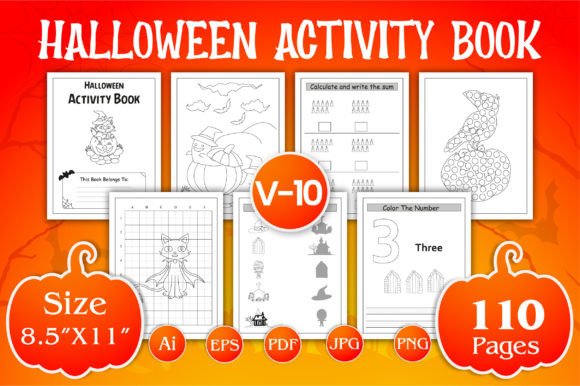
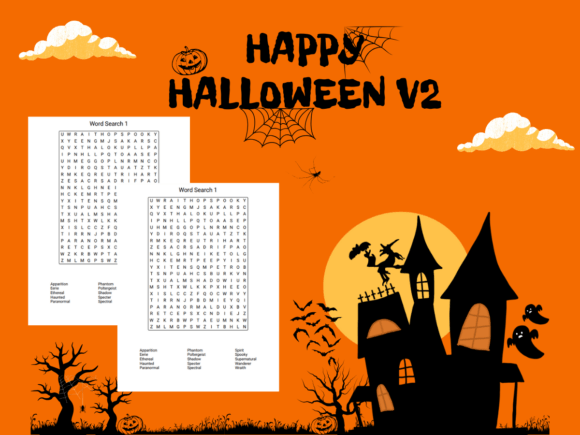
At its core, a Halloween word search interior is a collection of puzzle grids arranged across standard letter-sized pages. Each puzzle presents a themed word list drawn from Halloween vocabulary, seasonal phrases, or spooky terminology. The dimensions are fixed at 8.5” x 11”, which is the standard US letter size and the most common trim size for print-on-demand books. The interior is typically black and white to keep printing costs low and ensure legibility across different printers and paper stocks.
A professional interior includes several structural elements:
- Puzzle pages containing the letter grid and the list of hidden words
- Solution pages placed at the back of the book, usually with each puzzle answer clearly marked
- Consistent formatting across all pages, including margins, font sizes, and grid spacing
- High resolution at 300 DPI to ensure crisp output when printed
The presence of solutions in the back is not just a convenience. It adds value for the end user who may get stuck on a tricky word, and it also signals completeness to platform reviewers and potential buyers. For publishers, having solutions included reduces the risk of negative reviews from frustrated customers.
Where Halloween Word Search Interiors Fit in a Content Workflow
If you are producing activity books, the interior is the most time-intensive component to create from scratch. Outsourcing or using a pre-built Halloween word search interior can dramatically compress your production timeline. Instead of spending hours designing grids, testing word placements, and formatting solution pages, you can focus on cover design, book description writing, and keyword research.
For educators and seasonal program coordinators, a ready-made interior can be printed in bulk for classroom use, after-school programs, or community events. The black-and-white format means you can reproduce it on any office copier without worrying about color ink costs. The 8.5” x 11” size fits standard filing systems and binders, making it easy to store and reuse year after year.
For marketers and small business owners, a Halloween word search interior can serve as a low-cost lead magnet. Offer a downloadable PDF on your website in exchange for an email address. Since the content is evergreen within the season, you can promote it every October with minimal updates. The high-resolution 300 DPI format ensures that even if users print it at home, the quality remains acceptable.
If You Are a Self-Publisher on KDP or IngramSpark
Start by confirming that your interior file matches the exact specifications required by your platform. For a 8.5” x 11” book, the bleed settings, margin widths, and page count must all align. A pre-built Halloween word search interior typically comes as a print-ready PDF with all pages numbered and solutions included. Before uploading, run a quick checklist: verify that the resolution is 300 DPI, check that no puzzle words are repeated in a way that causes confusion, and ensure that solution pages are correctly keyed to their corresponding puzzles. Some publishers prefer to place solutions at the very end, while others intersperse them after each puzzle section. Either approach works as long as it is consistent and clearly labeled.
If You Are an Educator or Program Coordinator
Print one master copy and make a few observations. Check that the font sizes are large enough for your age group. Many Halloween word search interiors use a standard 10- to 12-point font for the grid letters, but if you are working with younger students or seniors, you may want to enlarge the pages on a copier. Because the source file is high resolution, scaling up will not introduce pixelation. Also, consider laminating a few copies to create reusable puzzles for classroom stations. Students can use dry-erase markers, and you can wipe them clean for the next group.
If You Are a Freelancer or Content Creator
A Halloween word search interior can be repurposed into multiple content formats. You can extract individual puzzles to use as social media posts, email attachments, or bonus content for a newsletter. Because the PDF is already formatted and print-ready, you do not need to redesign anything. Just open the file, select the pages you want, and export them as images or smaller PDFs. The black-and-white nature keeps file sizes small, which is helpful when sending via email or uploading to platforms with size limits.
Quality Control and Consistency Checks
Before you distribute or publish any Halloween word search interior, run through a few quality control steps. First, scan every puzzle for duplicate words. A well-constructed interior should have a unique word list for each puzzle, with no overlap in solutions. Second, verify that the word list matches the puzzle grid. It is surprisingly easy for a misaligned PDF to show a different set of words than what is actually hidden in the grid. Third, check the solution pages against the puzzles. Solutions should clearly indicate the correct path for each word without ambiguity. If the solutions use shading or circles, ensure that the marks do not obscure the letters beneath them.
Consistency across pages matters more than you might think. If puzzle one uses a 15x15 grid and puzzle three uses a 10x10 grid, the user experience becomes uneven. A professional Halloween word search interior maintains consistent grid sizes, or at least clearly signals the difficulty level on each page. Some interiors group puzzles by difficulty, with easier puzzles at the front and harder ones toward the back. This structure works well for books intended for mixed-age audiences.
Long-Term Use and Seasonal Rotation
One of the strongest arguments for investing in a well-built Halloween word search interior is its reusability. Unlike a blog post that loses relevance after the holiday, a print-ready puzzle book can be sold or distributed every year with only minor updates. If you own the file, you can rebrand the cover, update the title, or adjust the trim size slightly to target different platforms. The interior content itself stays effective because Halloween vocabulary changes very slowly. Words like “pumpkin,” “ghost,” “candy,” and “costume” remain relevant decade after decade.
For publishers with multiple titles, a series of seasonal word search interiors can form the backbone of a catalog. Once you have a Halloween interior, you can apply the same formatting template to create Thanksgiving, Christmas, Valentine’s Day, and Easter versions. The structural work is already done. You only need to swap the word lists and adjust the theme. This repeatable workflow saves significant time and ensures that your entire seasonal line has a consistent look and feel.
Integration with Other Tools and Methods
A Halloween word search interior does not exist in isolation. It interacts with your design software, your print provider, your distribution platform, and your audience. If you use a tool like Canva, Adobe InDesign, or Affinity Publisher, the PDF must be compatible with your export settings. Check that fonts are embedded or outlined, that transparency is flattened, and that color profiles are set to grayscale if the file is black and white. Some interiors come with embedded fonts that may not render correctly on every system, so it is wise to open the file and verify that everything displays as expected before sending it to print.
If you plan to sell through print-on-demand, the interior must also pass platform review. KDP, for example, automatically checks PDF files for resolution, bleed, and margin compliance. A pre-built Halloween word search interior that is marketed as “print-ready” should already meet these standards, but it never hurts to run a preflight check using Adobe Acrobat or a similar tool.
Practical Observations on Organization and Efficiency
When working with a multi-puzzle interior, organization saves time. Name your files clearly so that you always know which version is the latest. If you are customizing the interior, keep the original unmodified copy as a backup. Use folder structures that separate the master file from print-ready exports. If you are collaborating with a designer or a formatter, agree on naming conventions early to avoid confusion.
Efficiency also comes from understanding your production cycle. If you are publishing for Halloween, aim to have your interior finalized and uploaded by early September. This gives you time to order a proof copy, make any necessary adjustments, and launch before the seasonal buying window peaks. Halloween activity books tend to sell well from mid-September through October, so timing matters.
Final Considerations for Integrating Halloween Word Search Interiors into Your Routine
Whether you are a one-person operation or part of a larger team, a Halloween word search interior can simplify your workflow if you approach it with clear expectations. Know what you are getting: a set of puzzle pages with solutions, formatted to standard dimensions at high resolution, ready for black-and-white printing. Understand where it fits in your process—whether that is during the content creation phase, as a standalone product, or as a supplemental resource. And plan for reuse so that the work you put into sourcing or customizing the interior pays off across multiple seasons and projects.
By treating the interior as a modular asset rather than a one-off project, you reduce repetitive work and maintain consistent quality across everything you produce. That is the practical value behind a well-constructed Halloween word search interior, and it is why publishers, educators, and creators continue to rely on this format year after year.