The Teen Boundaries Workbook: A Practical Tool for Building Healthier Relationships
Boundaries work is rarely a one-time conversation. It is a skill that develops through repeated reflection, real-world practice, and honest self-assessment. For anyone guiding teenagers through this process—whether as a parent, educator, therapist, or mentor—a structured resource can make the difference between abstract advice and genuine understanding. The Teen Boundaries Workbook, offered as a fully editable Canva template, gives you a repeatable framework for helping young people identify, articulate, and practice their boundaries in a way that feels concrete and personal.
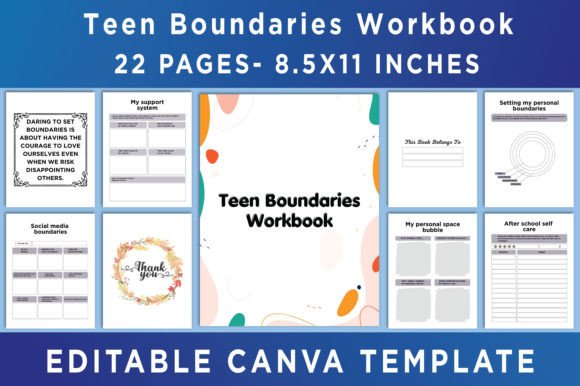
What makes this resource particularly useful is that it is not a static PDF. You receive high-quality print-ready files in PDF, JPEG, and PNG formats, plus an editable Canva link that allows you to customize every page. This means you can adapt the content for a specific teenager, a classroom setting, or your own professional toolkit without starting from scratch. The workbook includes twenty-two templates at print dimensions of 8.5 by 11 inches, with CMYK color and 300 DPI resolution. There is no bleed, so the layout is straightforward to print at home or through a professional service.
What the Workbook Covers and How It Fits Into a Process
The workbook moves from self-awareness to practical action. It starts with fundamental questions—What Are Boundaries? and Healthy Boundaries Versus Unhealthy Boundaries—then guides the user through a series of reflective exercises and prompts. This structure mirrors a logical progression: understand the concept, recognize where you currently stand, identify areas that need change, and practice new behaviors.
The included pages are not random activities. Each one serves a specific function in the boundary-setting process:
- Belongs To Page establishes ownership and personal commitment.
- Today’s Mood builds self-awareness as a prerequisite for boundary work.
- Things I Will No Longer Tolerate helps translate frustration into clear statements.
- What Boundaries Sound Like provides language models for real conversations.
- After School Self Care connects boundary setting to daily routines and emotional regulation.
- Signs That You May Need to Set Boundaries teaches pattern recognition.
- My Personal Space Bubble visualizes comfort zones in a tangible way.
- How to Say No and The Art of Saying No offer scripts and repetition.
- Benefits of Setting Boundaries reinforces motivation.
- Setting My Personal Boundaries moves from reflection to declaration.
- Boundaries Challenge encourages real-world practice over a set period.
- Social Media Boundaries addresses a high-stakes area for most teens.
- My Support System identifies who can help maintain boundaries.
- Quotes and Affirmations provides ongoing reinforcement.
- Notes and Thank You pages offer space for follow-up and closure.
You can use the workbook sequentially, as a complete curriculum, or pick individual pages based on a specific need. If a teenager is struggling with peer pressure online, for example, you might start with the Social Media Boundaries page and then move to How to Say No. The modular design respects the reality that boundary work is not linear for everyone.
Using the Canva Template Before, During, and After Implementation
The editable Canva link changes how you prepare and deliver this content. Before you introduce the workbook to a teen, you can review each page and adjust the language to match their age, reading level, or personal circumstances. You might add examples that are relevant to their school environment, replace generic prompts with specific situations they have mentioned, or incorporate their favorite colors and fonts to increase engagement.
During the process, you can print fresh copies of individual pages as needed. If a teenager completes the Boundaries Challenge and wants to revisit the My Support System page a month later, you simply print that single sheet again. Because the original files are editable, you can also track progress by filling in responses digitally and saving updated versions over time. This is especially useful in a therapeutic or educational setting where records of growth are valuable.
After the core work is done, the workbook remains a reference. You can revisit the Quotes and Affirmations page for ongoing encouragement, or use the Notes section to document what worked and what did not. The clean, print-ready format means you can bind the completed pages into a personal handbook that the teenager can keep. The long-term value comes from having a record of their own thinking at a formative age, which they can look back on as their understanding of boundaries matures.
Practical Implementation Tips for Different Settings
How you use the workbook depends on your role and the context. Here are a few ways to integrate it smoothly into your existing workflow.
For Educators and School Counselors
Print a class set of selected pages and use them as part of a social-emotional learning unit. The What Boundaries Sound Like and How to Say No pages work well for role-playing exercises. You can project the editable Canva template on a screen and fill it in together as a group, then have students complete their own copies individually. The Social Media Boundaries page fits naturally into digital citizenship lessons. Because you control the editability, you can modify the language each semester without redesigning the material from scratch.
For Therapists and Counselors
The workbook can serve as a structured intervention for clients who struggle with assertiveness, people-pleasing, or conflict avoidance. Use the Signs That You May Need to Set Boundaries page during an initial session to help the client identify patterns. The My Personal Space Bubble page is a concrete visual tool that works well with younger teens or those who process information better spatially. Between sessions, assign the Boundaries Challenge as homework, then review the results together. The editable format lets you tailor each page to the client’s specific relational context.
For Parents and Caregivers
You do not need a professional background to use this workbook effectively. Start with the Belongs To page to make the resource feel personal. Work through the pages at a pace that feels natural, perhaps one page per week. The Today’s Mood check-in can become a brief daily habit that opens the door to deeper conversations. If your teenager resists direct discussion, the workbook provides a low-pressure way to approach sensitive topics. You fill in your own copy alongside them, which models the behavior you are teaching.
For Teenagers Using It Independently
Some teens prefer to work through these topics on their own. The editable Canva link allows them to customize the workbook digitally, which can feel more private and less like a school assignment. The Quotes and Affirmations page can be printed and posted on a wall, and the Notes pages give space for unstructured reflection. If they want to share parts with a trusted adult, the clean print format makes it easy to hand over a single page without showing the entire workbook.
How the Workbook Interacts with Other Tools and Methods
The Teen Boundaries Workbook does not exist in isolation. It works well alongside other approaches you may already use. If you teach communication skills through role-playing, the What Boundaries Sound Like page provides sentence starters that can be practiced aloud. If you use journaling as a therapeutic tool, the Today’s Mood and Notes pages reinforce that habit. If you are implementing a school-wide social-emotional learning curriculum, the workbook pages can supplement specific units on self-awareness and relationship skills.
The print-ready files also give you flexibility in how you distribute content. You can email the JPEG or PNG files to families who prefer digital access, print the PDFs for in-person sessions, or upload selected pages to a learning management system. The consistent 8.5 by 11 inch format means everything fits standard binders and folders without resizing or cropping issues.
Preparing the Template for Long-Term Use
One practical detail worth noting: to keep the original link active, you must make a copy of the document in your own Canva account before editing. Open the link, go to your Canva home, and duplicate the template into your personal workspace. Work on that copy exclusively. This preserves the original structure and allows you to return to a clean version if you want to start over with a different teenager or group.
Once you have your copy, you can build a library of variations over time. Create one version with simplified language for younger teens, another with more detailed prompts for older adolescents, and a third that focuses specifically on digital boundaries. Because the template is fully editable, you are not locked into a single design. The CMYK color profile and 300 DPI resolution ensure that any colors or images you add will print accurately, whether you use a home printer or a commercial service.
Observations on Quality and Consistency
Workbooks in this space often fall into one of two traps: they are either too abstract to be useful or too prescriptive to feel authentic. This resource avoids both problems by combining clear conceptual explanations with open-ended prompts. The Healthy Boundaries Versus Unhealthy Boundaries page gives concrete examples without dictating what the user must think. The Setting My Personal Boundaries page asks for specific language, but the user supplies their own answers.
The file specifications matter for consistency. No-bleed documents are easier to print at home because you do not need to account for trimming. The 8.5 by 11 inch size is standard, so you can use off-the-shelf paper and binders. CMYK color ensures that if you do print professionally, the colors match what you see on screen. At 300 DPI, text and graphics remain sharp even if you enlarge a page for display or reference.
If you are someone who works with teenagers regularly, having a reliable, repeatable framework saves time and mental energy. You are not reinventing the conversation each time. You pull out the workbook, choose the page that fits the moment, and let the structure do part of the work. The editable nature of the template means it evolves with your needs rather than becoming stale after a single use.
The Teen Boundaries Workbook is a practical tool for a subject that deserves more than abstract advice. It gives teenagers a way to see their own boundaries clearly, practice the language they need, and build habits that will serve them long after the workbook is complete. For the adults guiding them, the combination of print-ready files and an editable Canva template offers the flexibility to adapt without sacrificing quality.